One of my recent cases involved a young man who had been vilified by the mother of one of his friends and her attorney. The defamation was spread massively through social media, and the multi-million-dollar damages award was based in large part on the large degree of exposure the false narrative received. Read on for more details:
Backround: In middle school, he had invited his friend to a sleepover along with a few other boys. The boys had played with each other and had gotten along well, and that evening, my client and his friends had played a bad prank on the boy in question. It was not significant during the sleepover, but my client and the other boys who played the prank were white, and the boy who had the prank played on him was black. This was not significant at the time, because whoever had fallen asleep first would have likely been the target of the prank. The prank was played, the kids laughed, and everyone went home happy afterward. The boy who had had the prank played on him did not really know what the other kids had done, but it did not particularly affect him, and he had just gone back to sleep.
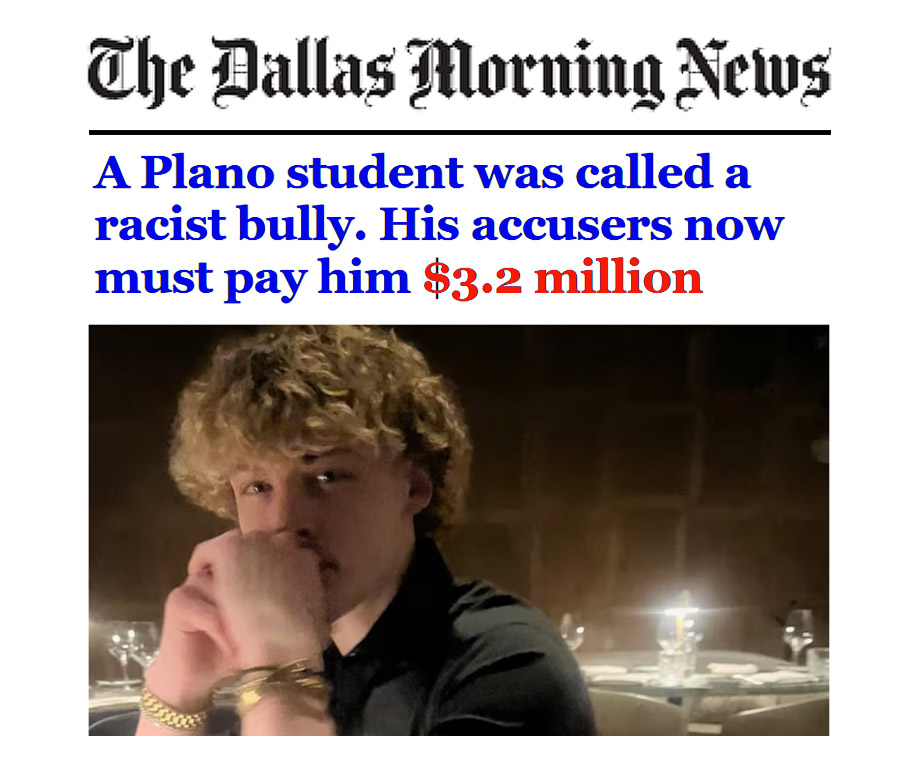
But, a couple of weeks later, the boy who had had the prank played on him had a falling-out with one of the other boys. They had played a video game together and had a dispute about it. The white boy threatened to release a video at school of the prank played on the black boy in order to embarrass him. The boy’s mother found out he was being threatened and she found out about the video and the prank, and she thought that he had been targeted because of his race.
The black boy had apparently previously experienced racial prejudice and some bullying experiences at school, and the mom believed the sleepover prank was yet more racism and bullying.
The mom demanded that the school suspend or punish the boys from the sleepover. She signed up with an attorney, they called for a protest at the school, and they gave interviews with major news organizations. They conflated previous, separate racism and bullying incidents the boy had experienced with the prank at the sleepover. In other words, beyond the prank itself, they made it seem as though the boys at the sleepover had also yelled the “N-word” at the boy, shot him with BB guns, hit him in the genitals, withheld his inhaler from him, and more. The mother named the boys involved on her Facebook page, and in media reporting, she called them “evil”. The mother and attorney set up GoFundMe pages and promoted them, conveying that it would be to get the boy counseling for the bullying, and to help him in his education.
At this point, the news coverage of the story, which featured a heavy emphasis on the purported racist bullying, spread, and also the story took off on social media platforms. It particularly took off on TikTok in social media, with hundreds of videos and video comments posted. Many, or even most of these, reflected multiple statements about the boys that were factually untrue. These statements included stating that they had:
- Bullied the black boy
- Abused him
- Called him racist slurs, such as the “N-word”
- Called him homophobic slurs
- Beaten him
- Hit him with belts
- Hurt his genitals
- Sexually assaulted him
- Physically assaulted him
- Harassed him
- Degraded him
- Urged him to commit suicide
- Attempted murder by taking away his inhaler and keeping him from it
- Taking away the inhaler during an asthma attack
- This was a racially motivated attack
- Tortured the boy
- Shot him with BB guns
- Abused him for hours
- Subjected him to physical abuse
- Subjected him to mental abuse
- “Forced” him to drink urine (this was the prank – they actually had tricked him to drink apple juice mixed with a little urine, but he was not “forced”)
- Committed hate crimes
- Committed heinous crimes against the boy
- Stole his inhaler while he was asleep
- That all this was “orchestrated”, “planned”, or “premeditated”
- They conducted this abuse for hours for “for 3 days”
In fact, there were so many negative and damaging imputations, described in multiple ways, that it was difficult to list them adequately. The boys were also called criminals, perpetrators, abusers, racists, and bullies. The white boys’ names were repeatedly listed out along with the negative and damaging imputations, despite them being young teenagers at the time.
There was so much content posted on TikTok that it was challenging to get an accurate count. I was able to show that there were multiple hashtags used by those posting about the incident and the allegations. The primary hashtag had 2,087 videos associated with it:
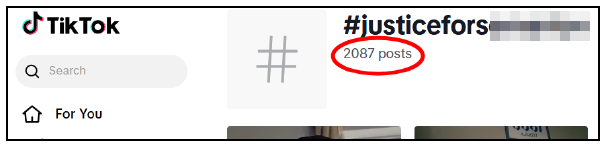
However, there were multiple other hashtags in addition to this one, because the boy’s name was unusual, resulting in a number of misspellings. There were alternate hashtags that included his last name, left out “justice” or added other words like “bullied” and “abused”, or included emojis. In all, the sum total of hashtags established there were at least 3,998 videos posted about the incident, and all were consistently negative about the Plaintiff, my client, in this lawsuit. Of course, there were likely many more videos posted that did not include hashtags, too.
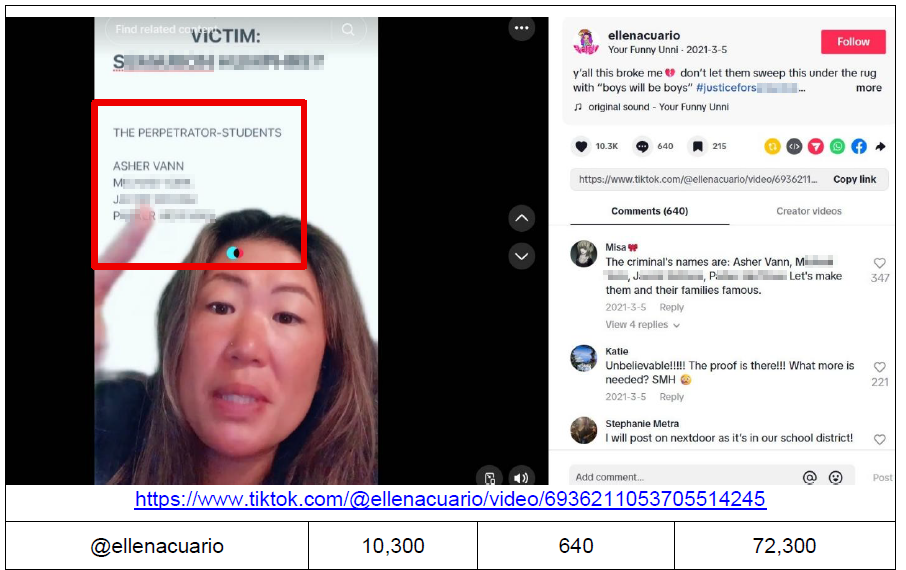
Of course, some of the more experienced TikTokers are perhaps careful about naming names, since they could be sued for defamation. But, some of them cited the boys directly by their names, and on videos that did not, other people frequently posted the boys’ names in the comments, making them identifiable. For instance, in the following TikTok video by @EllenAcuario, the boys’ names were listed in the video itself and in a comment. This post was liked over 10,000 times, had 640 comments, and was viewed 72,300 times:
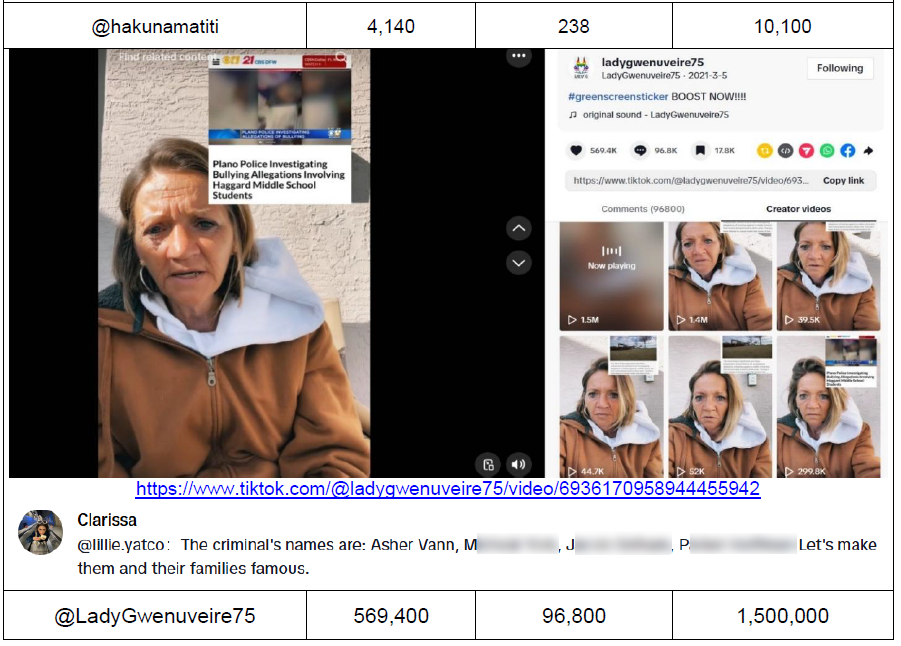
In another example, TikToker @LadyGwenuveire75 posted a video, urging other TikTokers to “boost” her video (asking them to repost it and like it), and her video received 1.5 million views, over 500,000 likes, and over 96,000 comments. Also, Tiktoker @Clarissa “helpfully” added a comment, calling the boys criminals, and naming each of them.
In yet another example, TikToker @AriesTings posted about the claims of abuse and claims of wrongs committed by the boys. As the screengrab shows, she posted exaggerations about the actual prank (he was not “forced”) and an exaggeration about the sleepover (he was not “assailed with a BB gun” — he participated in shooting the BB gun and was not upset with the interactions he was included and participated in). It also repeats the completely false claims like having his respirator withheld and that he was called racial and offensive slurs, and that he was physically assaulted, etc:
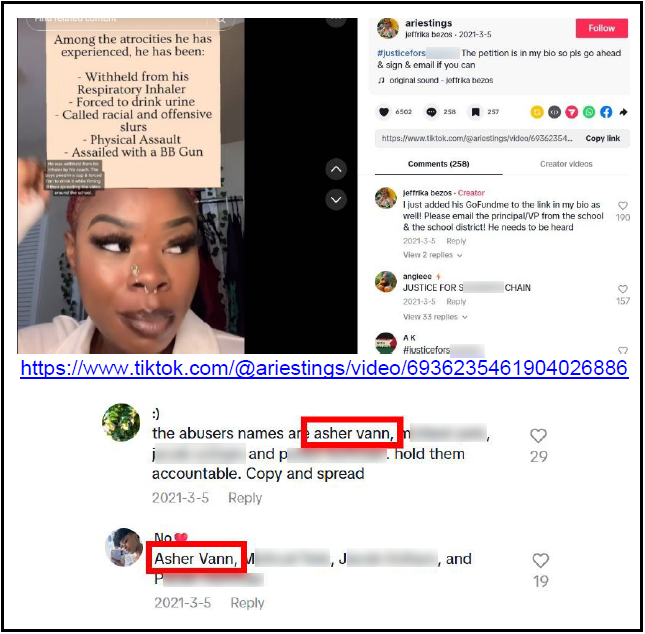
The post received 6,500 likes, 257 comments, and almost 18,000 views. Some of the commenters also named the white boys.
While all these TikTokers were deeply irresponsible in reposting claims and allowing children to be named in such accusatory videos, especially prior to any sort of due process or official legal conviction. (Of course, Plano police had investigated and found there were not grounds to file charges.) The TikTokers were understandably outraged at such horrific accusations, and the picture that was depicted in the stories of the black child, supposedly invited to a sleepover with “racist” white boys under false pretenses, who then abused the boy multiple ways. While the TikTokers bear some responsibility for being a bit gullible and allowing themselves to be manipulated and used in the defamation campaign against these boys, the story unfortunately felt believable, and it was extremely compelling.
Hopefully, those TikTokers who replicated, published, and distributed the false, deceptive, and exaggerated story will come to understand how deceived and wrong they were, and will remove the videos.
Combined with views from the news site articles that covered the false claims, the total number of views of defamatory material came to 8,389,164. That represents an incredible number of people who received a negative impression about my client and the other children.
While there were many TikTokers who reiterated the false representations about the boys, the persons who were proximally responsible were the black boy’s mother and their attorney. When they repeatedly announced the claims about racism and bullying, along with the description of the prank played on the boy at the sleepover, it was essentially inevitable that the public would conclude that the boys were responsible for all of the terrible acts that were described. The mother and attorney knew that the stories were getting conflated. They may have allowed it, or might have even intended it in order to make the entire tragic story more dramatic. It could easily be seen that the claims and negative imputations about the boys were getting conflated and were worsening, but the mom and attorney allowed it to happen instead of clarifying to people that the story was very inaccurate.
By setting up the compelling and horrific story, the two women set the match to the powder keg. They launched the false story, so they are responsible for how it snowballed into a hugely destructive dynamic.
While the mom did eventually delete her Facebook post that named the accused boys publicly, the damage was already done, and they did not intervene, post a correction, post a retraction, or post a clarification at any point. Even after the lawsuit was filed against them, they could have begun publishing a correction statement, but they did not.
I believe the Plaintiff’s counsel asserted that there was a monetary motive intertwined with the promotion of the false narrative. The counsel seemed to suggest that the defendants had used the false and defamatory narrative as a vehicle to persuade people to donate to the GoFundMe pages. I believe there is something to this, because the money was not used solely for the allegedly bullied boy’s counseling and education — it’s possible that not even the majority of the donated money was used for the counseling and education. Apparently, some large chunk of the money was used for a vacation and perhaps other expenses. The allocation of that money was an issue as well, as the mother did not comply with the court-ordered discovery of the financial information, resulting in the court sanctioning the two defendants.
I gave testimony in court during the trial, and I presented my findings on what the many social media posts stated about the Plaintiff, how many videos and news stories were posted online, how many people viewed that media, and how it was a conservative amount and an undercount, since it was impractical to try to identify all the videos and how many views they all got. I had identified a sufficient number to make the point, and beyond that, working to identify more was an exercise in the law of diminishing returns and an unnecessary expense.
Based on the exposure, I recommended damages that further included estimated costs to counteract the negative impressions made online through a corrective advertising campaign and an online reputation management campaign. The damages were heavily based on the social media statistics that I developed.
The jury considered and returned a verdict in favor of the Plaintiff, awarding him $3.2 million.
It should be mentioned that the jury was racially diverse, so this was an objective result based on the facts, and was not a judgment based on some misguided racial solidarity or prejudice.