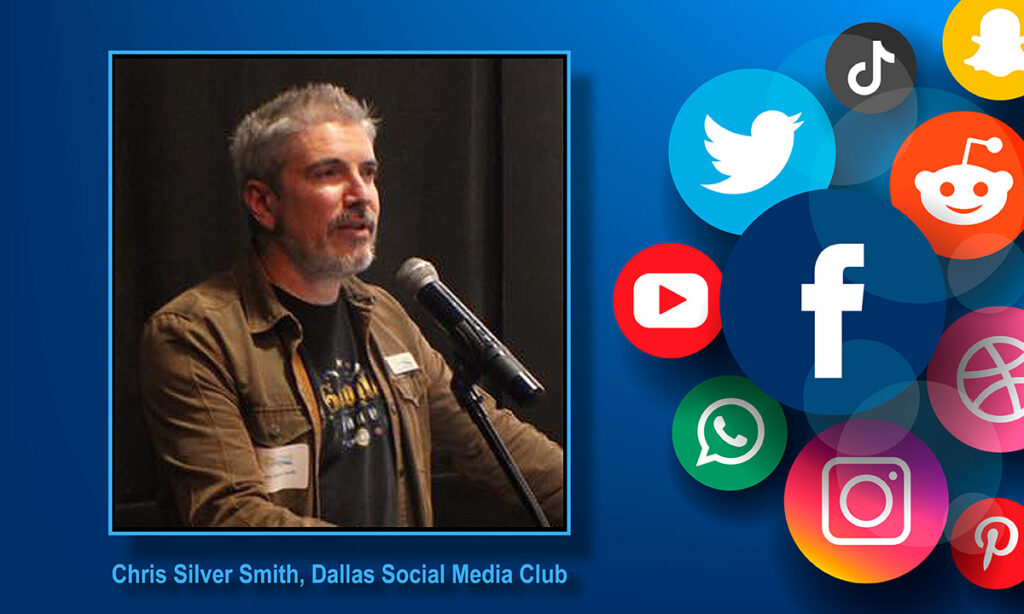
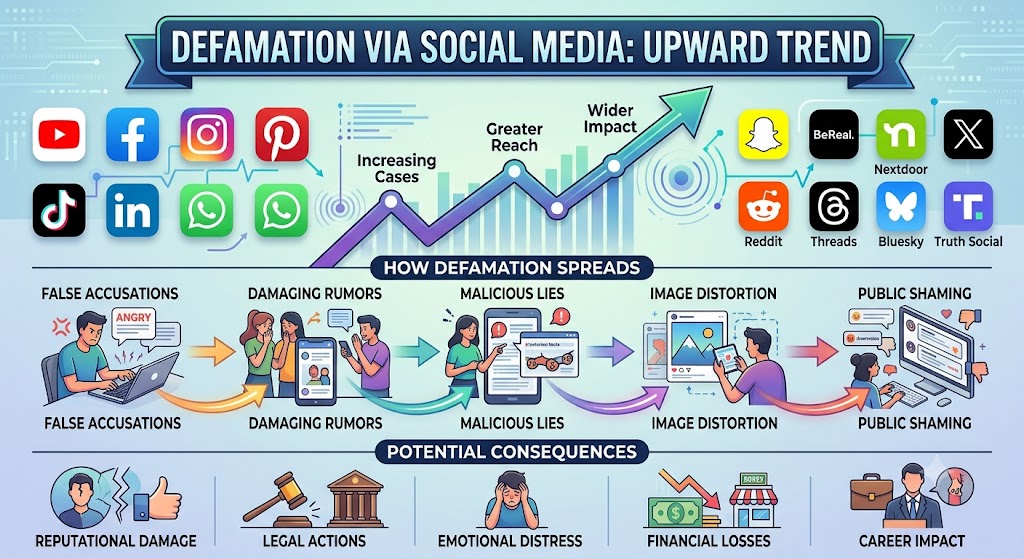
Data indicates a major surge in public interest involving defamation conducted through social media, including Facebook, X (formerly Twitter), Instagram, YouTube, TikTok, and more.
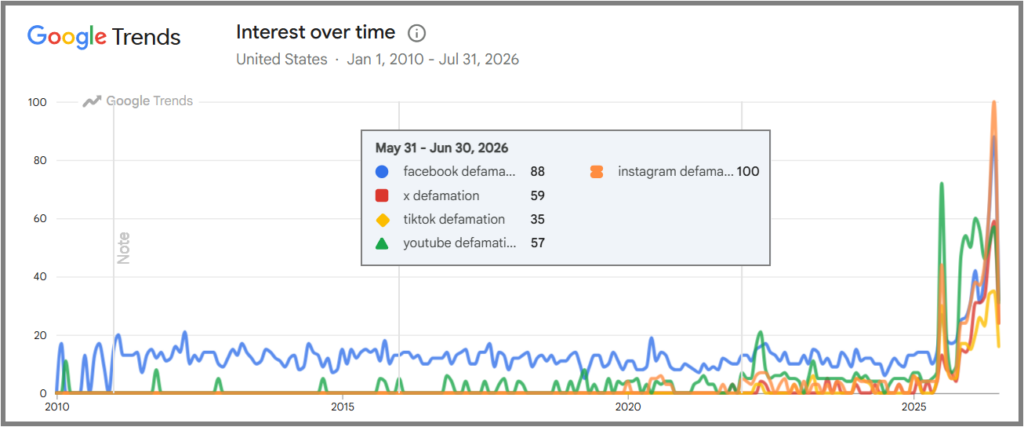
Google Trends is showing a significant uptick in searches involving top social media platforms from 2025 through July of 2026.
There are a lot of reasons this could be happening. For one, there has been continued growth for years in the usage of major social media apps. Read on to find out what is happening.
The Pew Research Center shows increases in nearly every social media platform — YouTube, Facebook, Instagram, Pinterest, TikTok, LinkedIn, WhatsApp, Snapchat, X (formerly Twitter), Reddit, BeReal, Nextdoor, Threads, Bluesky, and Truth Social:
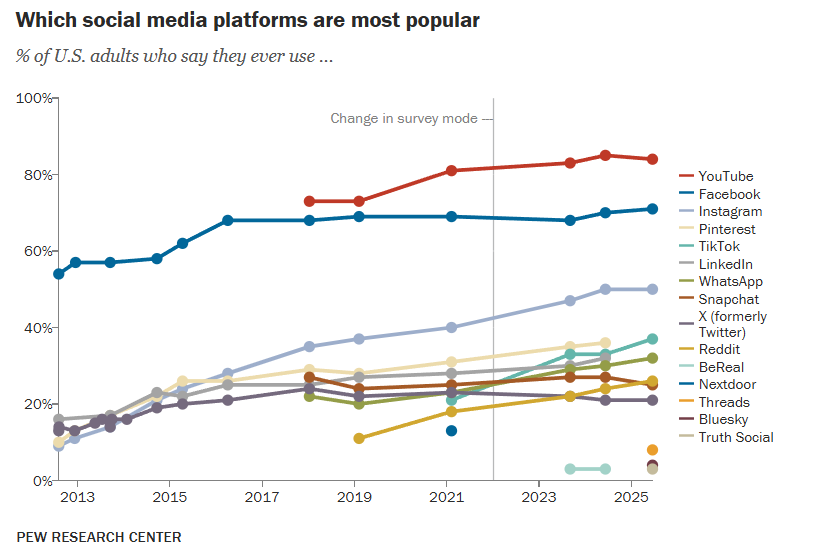
Source: Which social media platforms are most popular? Social Media Fact Sheet, Pew Research.
Not only has social media usage increased pretty consistently for the last decade-plus, but there also seems to have been a societal shift in the United States where individuals feel they have more license to say anything and everything, including false, damaging statements about individuals and companies.
There are additional reasons that may be contributing to this trend. The Defamation Expert Witness just published an article discussing why there is a related surge of searches for defamation attorneys.
As interest is increasing, as indicated by searches involving defamation and social media, it is likely that people are exploring how to stop and remove defamatory posts. One means of mitigating damaging and defamatory social media posts may be to contract an agency or a consultant that is specialized in Online Reputation Management. The Social Media Expert Witness has long provided reputation management services through Argent Media, a search engine marketing agency.
Another means of halting and removing defamatory posts in social media is to file a lawsuit for relief. This approach, while often costlier, has a number of significant advantages:
- Filing a lawsuit may have an inhibiting effect on the defamer. If you are enduring ongoing reputation assaults with repeated social media postings, putting the person(s) responsible on notice could have a desirable chilling effect. Of course, with some irrational people this may not stop them. (Also, be aware that if they are merely exercising acceptable free speech comprised of opinion and fact, filing a lawsuit may be opening yourself up to an Anti-SLAPP countersuit.)
- The court may issue an injunction barring your detractor from posting about you. While judges may be loath to limit an individual’s freedom of speech, they may be able to bar them from saying specific things about you once you have established that those things are false and damaging.
- A lawsuit may get defamatory social media posts deleted where nothing else does. If you prevail in a defamation lawsuit, the court may order the defendant(s) to remove social media posts that have harmed you. Deletion is an ideal scenario, since this can help improve your image rapidly.
- A court may award damages to compensate you for financial losses due to defamation. If you have lost your job, lost business, or otherwise lost income attributable to defamation published on social media, a court could award you damages for those losses.
- Costs of cleaning up a damaged reputation online can be another category of damages in a defamation lawsuit. When damage is particularly visible, the costs of cleaning it up can be substantial. If defamatory imputations were reported in news media, it may not be deletable, and online content can also spread onto websites where it cannot be deleted through court order, such as on some sites protected by Section 230 of the CDA, or foreign websites.
- A corrective ad campaign can repair misimpressions conveyed by defamatory content, and can add to damage awards. If many people have seen the defamation online, such as through social media, it may be possible for an expert to assess this and to determine the cost of mitigating the misimpressions by conducting a positive brand-building or personal image ad campaign in the same channels where the content was originally published.
- You may get compensated for emotional pain and suffering and invasion of privacy. Defamation claims are often also paired with claims of intentional infliction of emotional distress and invasion of privacy. Publicly calling for someone to be undeservedly shamed and doxxing individuals are tactics used by individuals to express hate, retaliate for something, or even to attempt to extort the target of their defamation campaign.
- Punitive or Exemplary damages may be assessed in a lawsuit in order to penalize the defendant(s) who defamed you. This is often a necessary repercussion to deter them from continuing or repeating the defamatory attack on your reputation.
- Defamers can also be charged with related criminal offenses in some instances. While rare, certain types of defamation can be deemed to be criminal offenses in some jurisdictions, or when they are also a part of other criminal activities. Crimes can include: porn revenge, sextortion, extortion, doxxing, hacking, advising or encouraging suicide, harassment, stalking, and more.
If you are considering filing a lawsuit for defamation conducted through social media, Chris Silver Smith, the Social Media Expert Witness, could be a significant asset for your litigation.
Chris Silver Smith has served as an expert witness in multiple lawsuits involving social media, social media analytics, and defamation conducted through social media. He has a background in providing Online Reputation Management services to companies and individuals, and this experience can be invaluable in legal cases. Smith can often assist the court in calculating appropriate damage awards for defamation claims, and his work has helped contribute to multiple clients receiving million-dollar-plus damage awards and settlements.
Multiple research studies have established that including an expert witness in your litigation strategy can help in maximizing potential damage awards.
Smith has also worked with multiple attorneys and law firms across the country in defamation cases, and he can refer you to some if you are considering filing a complaint.
If you are in need of a Social Media Expert witness, contact us to explore options.